Aerospace Engineering · Moscow

Projects

Projects and research directions of Alex Wang: thrust vector control, landing dynamics, flight data processing.

Competition

Aircraft Design Competition · 2nd nationwide

Team of three universities (TU Munich, Beijing Film Academy): aircraft modelling, Simscale dynamics, parameter inversion and media work — 2nd place nationwide.

Simscale Stability Control Team
See details Collapse

Built the prototype model and ran Simscale dynamic simulations; analysed stability under disturbance and designed a preliminary attitude stabilisation scheme; reproduced a two-stage-to-orbit design from published aeronautical papers; owned the team's slide deck and numerical work, and handled submission and defence material with the organisers.
Internship · 6 weeks

GNC Control Algorithms Internship · Commercial Space

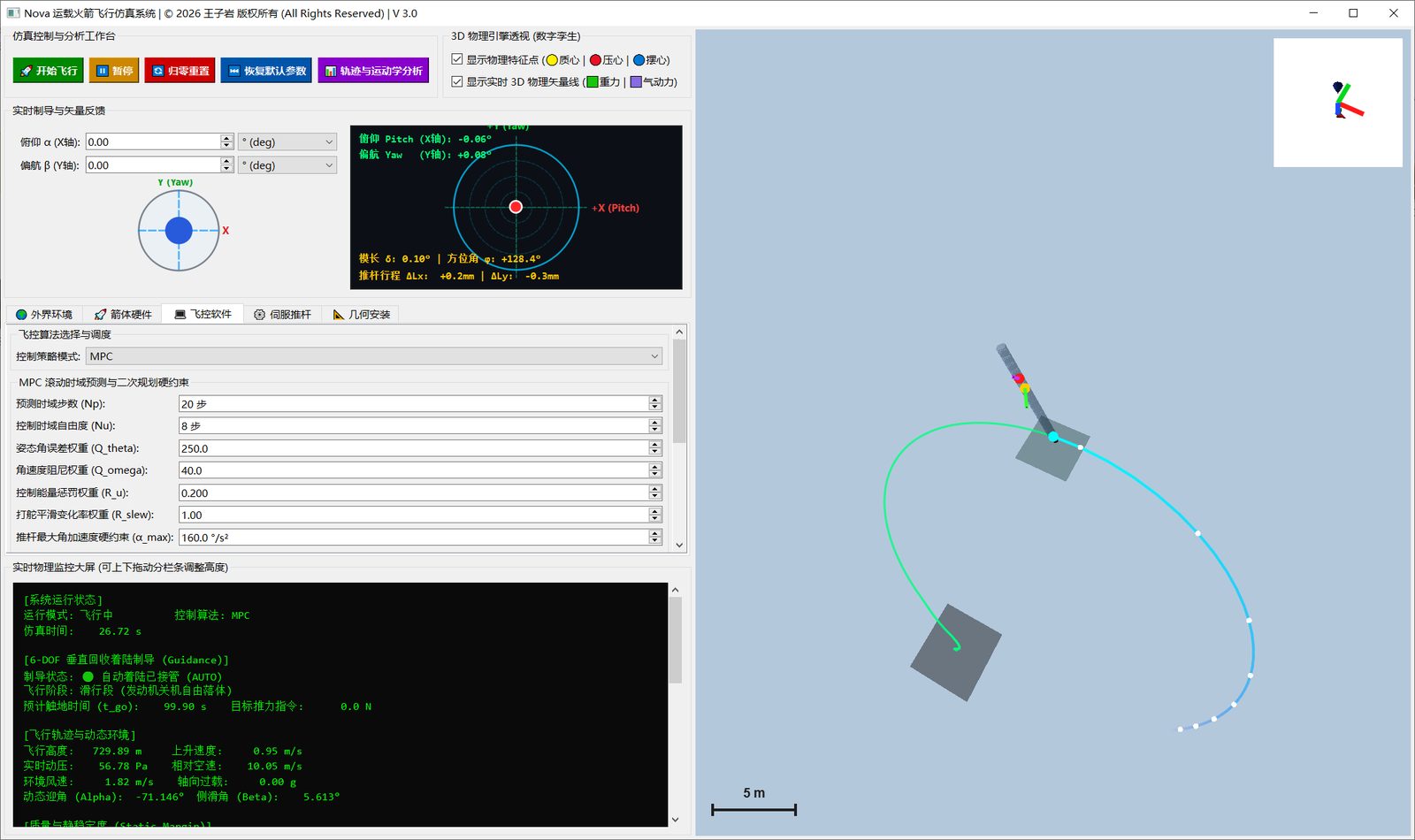
Avionics department of a leading small-to-mid-size Chinese launch company: built flight simulation software, studied PID / MPC and related control, and explored reinforcement learning for landing-phase tuning and disturbance compensation.

GNC MATLAB PID / MPC Reinforcement Learning
See details Collapse

Worked across the launch-vehicle development flow with a focus on the GNC system; developed an avionics flight-simulation program; studied PID and MPC control algorithms; explored RL for tuning and disturbance compensation on the recovery phase with simulation validation; coordinated with cross-functional teams and organised aerospace knowledge modules, technical docs and reading lists; contributed to landing-leg and non-pyrotechnic separation system studies.

Independent project

Agent-based Aerospace Software

A simulation-assist toolkit built on large models and vibe coding: DeepSeek / Gemini / Qwen APIs, agent workflow design, and open-source GNC projects broken down into runnable sub-models.

Agent LLM Python GNC
See details Collapse

Deployed and called DeepSeek, Gemini and Qwen models, built an interactive demo, completed API calls and agent workflow design; full-stack development via vibe coding with an aerospace simulation analysis module; integrated open-source reusable-rocket GNC projects from GitHub, decomposed the TVC vector-control system into concrete stages and built simulators.

GNC Launch Simulation

GNC Launch Simulation

A launch-phase simulation bench: rail departure, pitch-over and trajectory integration, with a parameter panel and live flight-state readout.

Parameterised initial mass, thrust, aerodynamics and guidance law; 6-DOF trajectory integration with live plots of path, altitude–velocity and attitude; control parameters can be swapped to compare responses.

MATLABApp Designer6-DOFTrajectory
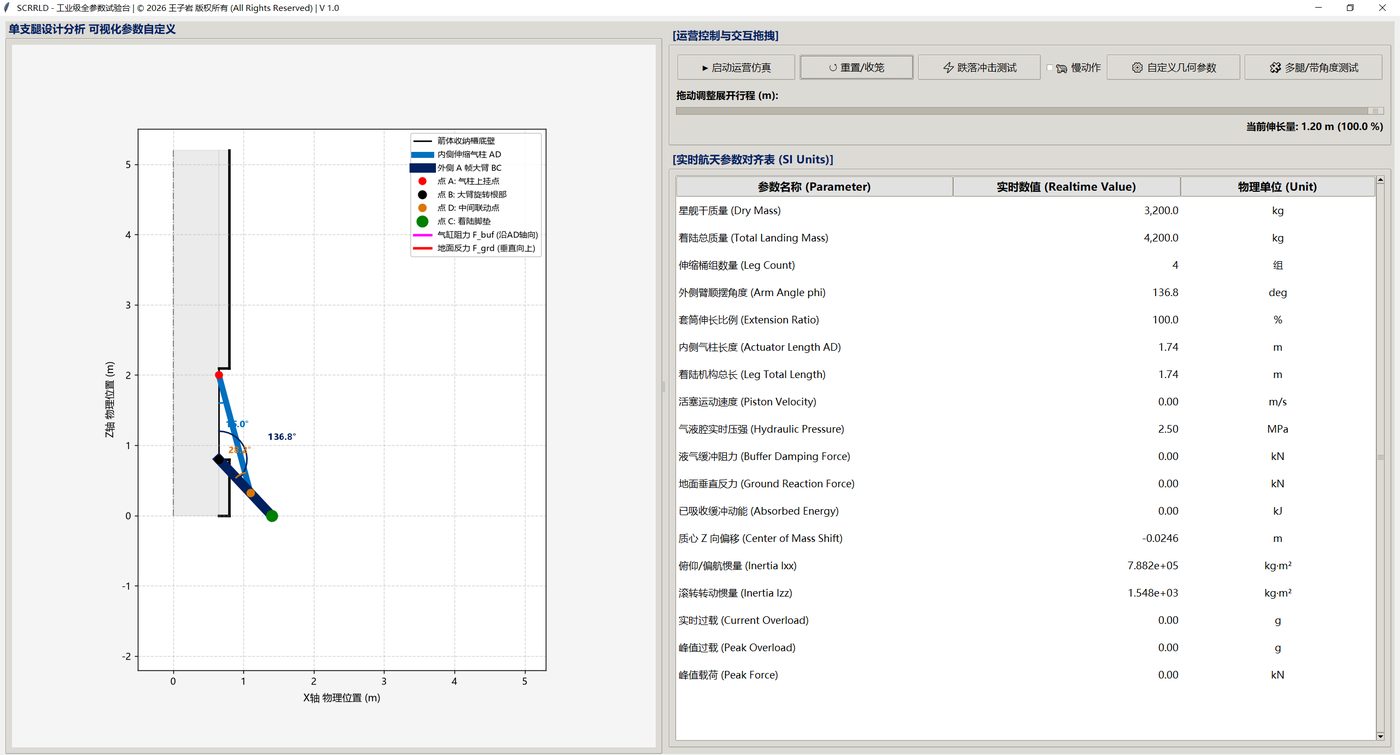
Landing Leg Research & Design

Landing Leg Research & Design

Parametric geometry and dynamics model of a landing leg: stroke–angle relation, matching touchdown impact against damper stroke, and control-law comparison.

Derived the kinematic relation between stroke and angle and analysed force transmission across configurations; built simulations comparing classical and nonlinear control laws during touchdown; evaluated system feasibility together with the non-pyrotechnic separation concept.

KinematicsLandingSimulationControl

Conference · 9th All-Russian Conference

Gimbaling Nozzle Servo System Design Study

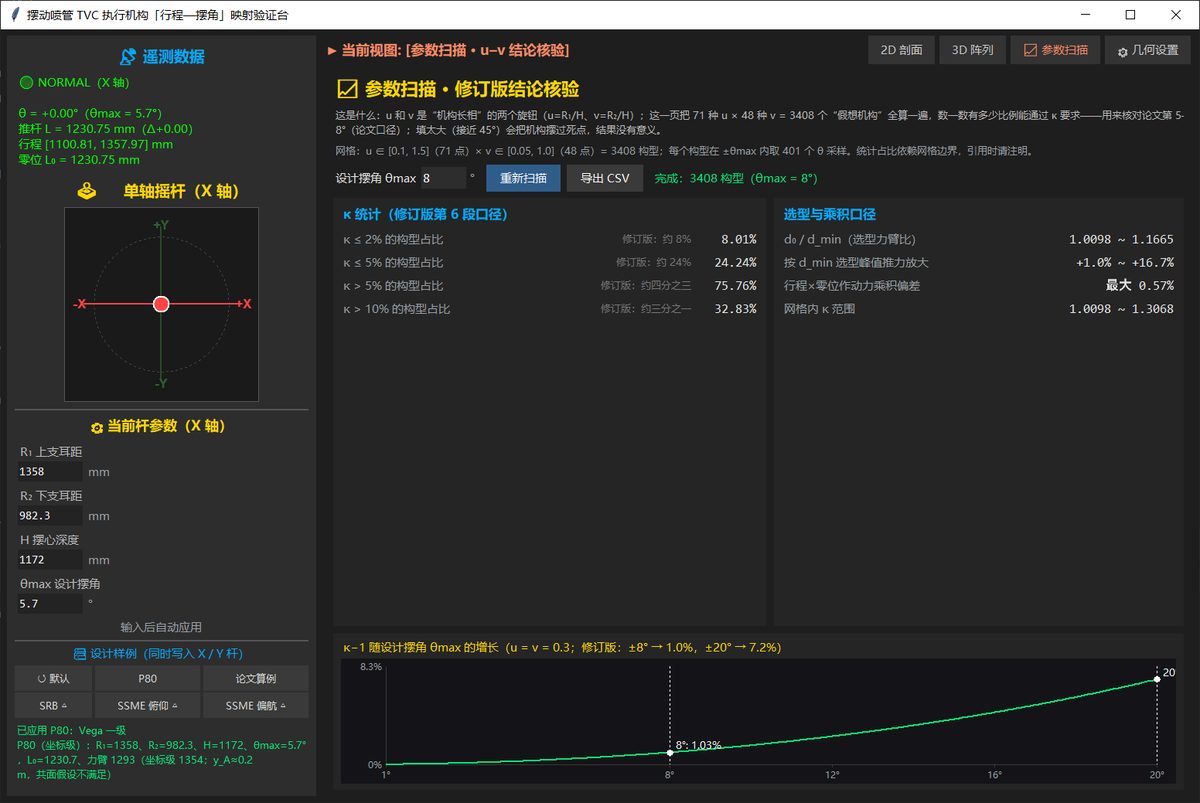
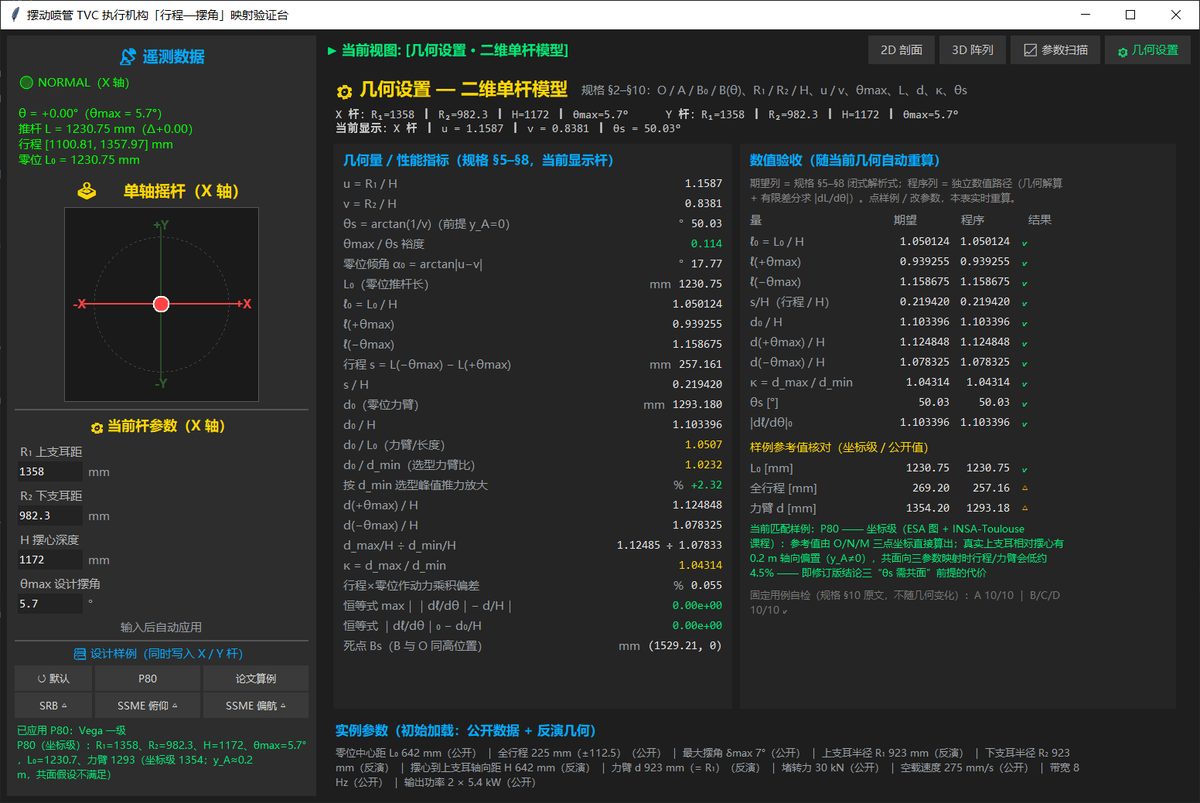
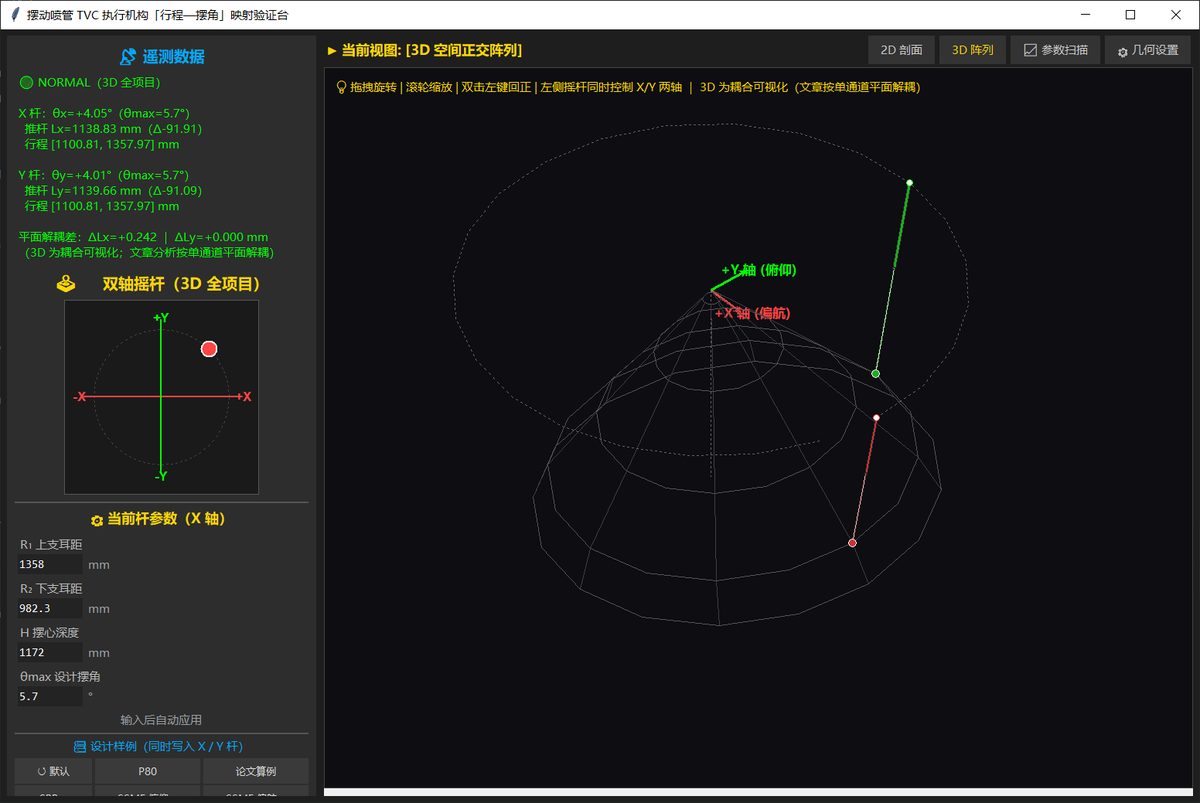
Parametric design study at Bauman's Spacecraft and Launch Vehicle department: the gimbaling nozzle's servo is usually reduced to two constants — here the geometry decides everything, through two dimensionless parameters (u, v).

TVC Parametric Design Kinematics Conference
See details Collapse

Presented at the 9th All-Russian Conference (supervisor: Dr. Prof. A. V. Egorov). Landing models collapse the servo drive into fixed angle and rate limits and lose the nonlinearity: the gimbal angle is produced by actuator stroke, and the stroke–angle relation is nonlinear and geometry-dependent. A planar single-channel model with four dimensionless metrics — normalised stroke, force arm, transmission scatter and singularity angle — characterises the mechanism; the force arm equals the transmission ratio identically, stroke nonlinearity is about 1% at ±8°, yet transmission scatter κ−1 reaches 5.1%, and that scatter is loop gain. In the design space u ≈ v gives the minimum scatter (κ ≈ 1.01–1.05); 76% of geometries exceed 5%.